Ask Me Directly
A question before you commit? I read these personally.
 First Edition · Limited to 50
Harmonic Contour · Private Allocation
Claustra No. 01
A perforated mineral lattice with 24K gold leaf laid by hand inside every fracture. Under flat light it reads as stone. Move the light and it does not.
$1,850
Standard Edition. Galleria Edition on honed Italian limestone, $3,200 in an edition of 12. Available in four payments.
Light Study
Two Objects, One Wall
Drag the divider. Nothing about the piece has changed between these two photographs except where the light is standing.
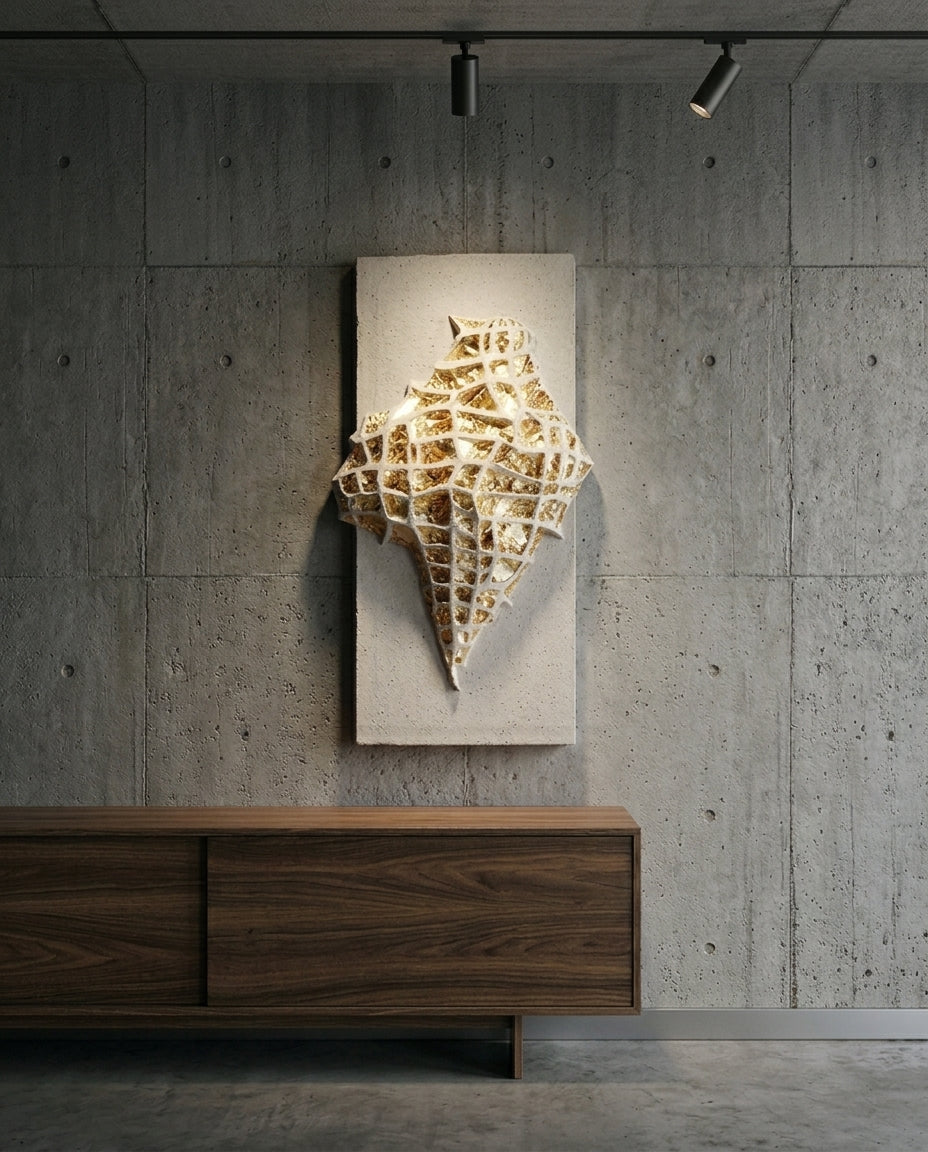
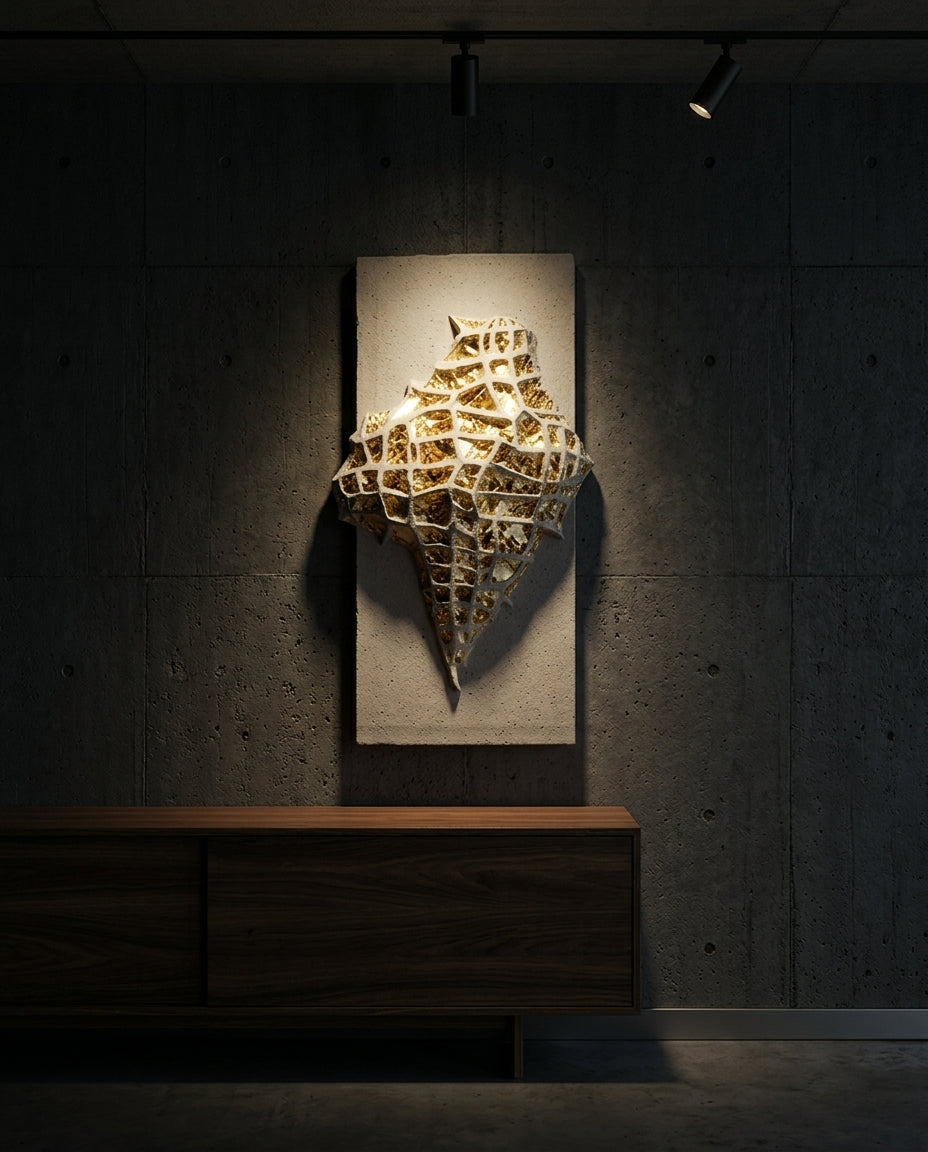
The chambers catch and hold.
A source set low and to one side reaches into the fractures the ribs normally shade. Each fragment of leaf returns light at its own angle, so the surface flickers rather than reflects — the behaviour of a mosaic, not of a polished metal. This is the hour the piece was calibrated against, and the reason the lattice was cast deep enough to hide the gold at any other angle.
The gold withdraws to depth.
Under high, diffuse light the ribs shade their own chambers and the piece reads almost entirely as stone: a pale mineral relief on a pale slab. The gold is present but withheld, showing as warmth in the recesses rather than as colour. Most wall art is designed to look its best in exactly this light. This one is designed to survive it.
The most valuable material in the object is the one you have to move to find.
Construction
Built Up, Not Carved Out
Three layers, applied in sequence, each one fixed before the next begins. Step through the build and the drawing assembles with it.
A fibre-reinforced concrete slab, cut square and left unhoned on its face. The fibre matrix is what allows the panel to carry the relief at this span without a steel frame behind it, and the aggregate is graded fine so the surface reads as stone rather than as concrete. The cleat channel is formed during the pour, not routed afterward — a routed channel in a fibre panel is a fracture line waiting for a season.
The lattice is cast in architectural plaster and set onto the slab as a single piece. Its cell structure is irregular by construction rather than by pattern: every rib meets its neighbours at a different angle, and no cell repeats. Casting texture, pinholes and the grain of the mould are retained. Polishing them out would turn a mineral structure into a moulding, which is the one thing this form must not become.
Genuine 24K leaf, laid by hand into each chamber behind the ribs, one fragment at a time, on a size that is worked while still tacky. The leaf is roughly a tenth of a micron thick and it breaks as it is laid — those broken and overlapping edges are the only reliable way to tell real leaf from imitation, and they are why the surface flickers between fragments instead of reflecting evenly. Adds no measurable depth and most of the labour.
The gold is applied last and is never sealed. A varnish would flatten it to a uniform sheen and remove the fragment-to-fragment variation that makes leaf read as leaf. It is left exposed, which is also why it must never be touched.
On Precedent
The Screen That Breaks the Sun
The term claustra is older than the object usually assumes — Latin for an enclosure, the same root that gives us "cloister" — but the form now associated with it belongs to the twentieth century. Architects rediscovered the perforated screen as a structural idea in the 1930s and 40s: a wall that filters instead of blocking, casting broken shadow rather than flat shade, dividing a room from the sun without sealing it from the light entirely. Le Corbusier's brise-soleil, built at scale on the Unité d'Habitation in Marseille in 1952, turned the logic into doctrine — the wall's job was no longer only to stand, but to edit what passed through it.
Claustra No. 01 keeps the discipline and drops the utility. It filters nothing; there is no room on the other side to cool or shade. What passes through its openings now is only light, and what the light finds inside is gold.
On Origin
Before Concrete, Wood
The modernist screen wall is not the form's origin, only its most recent name. Centuries earlier, the mashrabiya lattices of Cairo and the Levant did the same work in turned wood: filtering harsh daylight, drawing air through by the pressure difference across small openings, and allowing a view out without permitting one in. The material changed from timber to plaster to fibre-reinforced concrete; the geometry changed with each technology that could cut or cast it. What has not changed in eight centuries is the basic proposition — a wall is more interesting once it stops being solid.
On the Angle
Where the Gold Hides
Every chamber behind the lattice is gilded the same way, and almost none of them are visible from most positions in a room. A rib shades its own chamber the instant light arrives from above or straight on — the same geometry that makes the gold read as depth rather than colour under flat light is what makes it flare the moment a source drops low.
Nothing moves inside the object. Only the angle of what's lighting it does.
Same chamber, two angles of light
On the Leaf
A Tenth of a Micron
Gold leaf is not gold paint or gold-coloured foil; it is gold, beaten between sheets of specialty paper until it is thin enough to lose its colour in transmitted light — hold a sheet to a lamp and it shows green. Goldbeating survives as a named trade with its own guild history, centred for centuries in cities like Florence and Nuremberg, and the leaf it produces is still measured the way gilders have always measured it: in fractions of a micron.
The technique used inside each chamber here is mordant, or oil, gilding — a slow-drying size is brushed on and left until it is tacky rather than wet, and the leaf is laid onto that exact window. Too wet and the leaf drowns; too dry and it will not take at all. It is a craft measured in minutes of patience per fragment, which is most of what the object actually costs.
Claustra No. 01
Some objects are bought. This one is waited for.
There is no ship date attached to this piece and none will be published. Each cast is finished, gilded, and numbered before it is offered, not before it is ordered, and the list moves at the pace the gilding allows — which is to say, slowly, and without a schedule anyone outside the studio controls.
Fibre-reinforced concrete, architectural plaster, 24K gold leaf · 30 × 15 in, projecting 3.5 in from the wall · First Edition of 50, numbered and incised verso.