
L'Acanthe Pétrifiée
Ask Me Directly
A question before you commit? I read these personally.
Surface
Read the cast at four hundred percent
The finish is where this object is made or lost. Move across it, or stop at a marked point for the studio's note.
 Drag to inspect
Open grain
Nothing here is sealed smooth. The pores are left open so the surface reads as geology under a raking light rather than as a coating.
Casting Ledger
Now Casting
The stages between wax and finished stone.
34 pieces remain in this First Edition allocation.
- Model
- A wax positive is built by hand over an armature, leaf by leaf, before anything is cast.
- Mould
- A two-part plaster mould is pulled from the model and reinforced at the tendril junctions, where the form is thinnest.
- Wash
- The natural earth mineral wash is worked into the relief by hand, then drawn back off the raised edges before it sets.
Pre-Order — ships in 6–8 weeks. Made to order; your reservation confirms production.

Relief Study
The same stone, twelve hours apart
Relief only exists where light has a direction. Move the source across the surface, then change the hour and watch the leaves change with it.
Move across the surface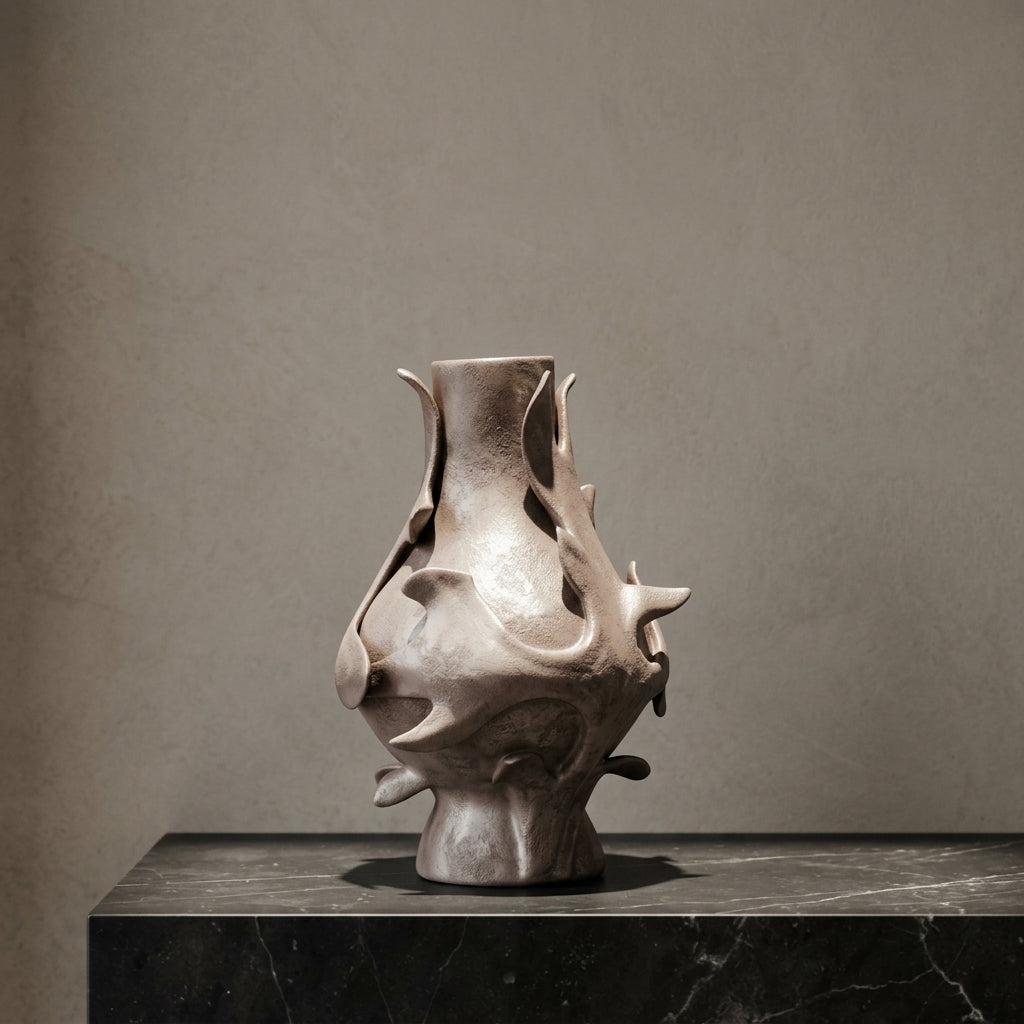
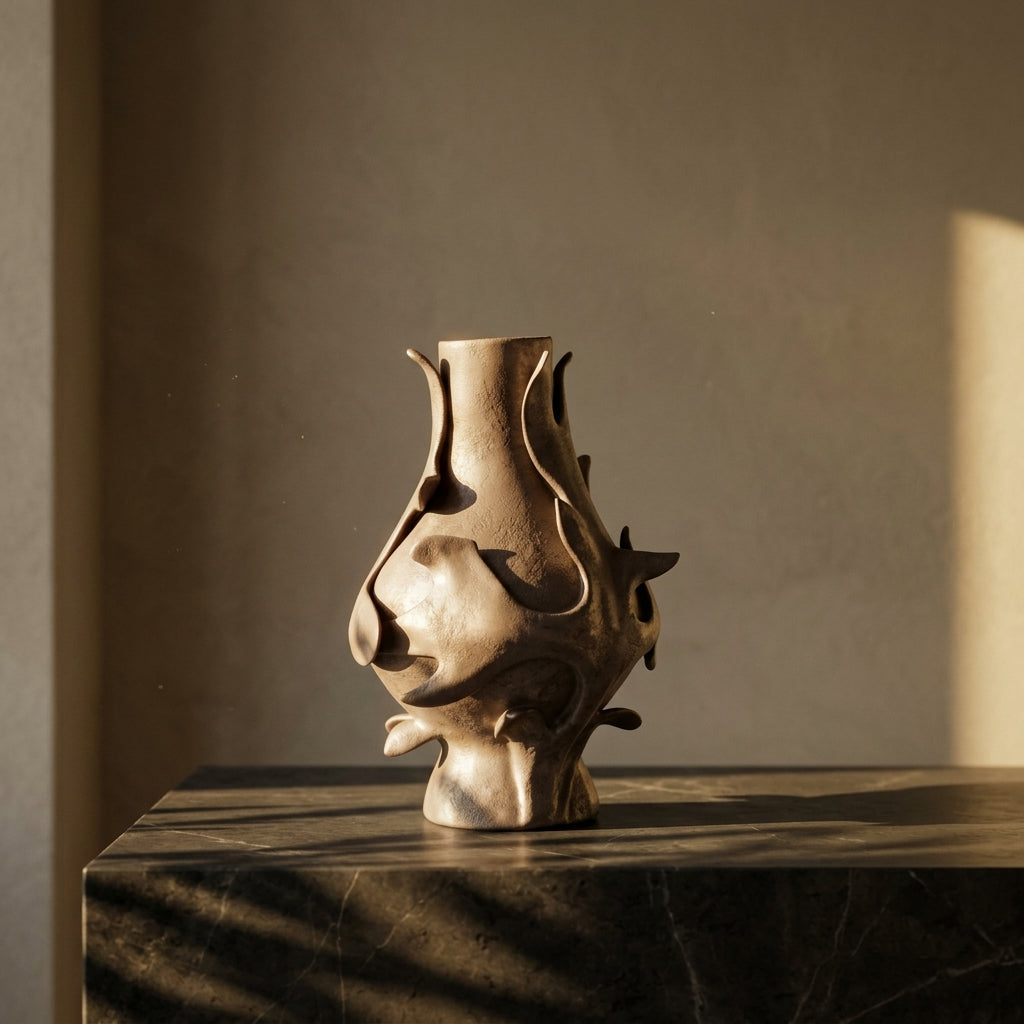
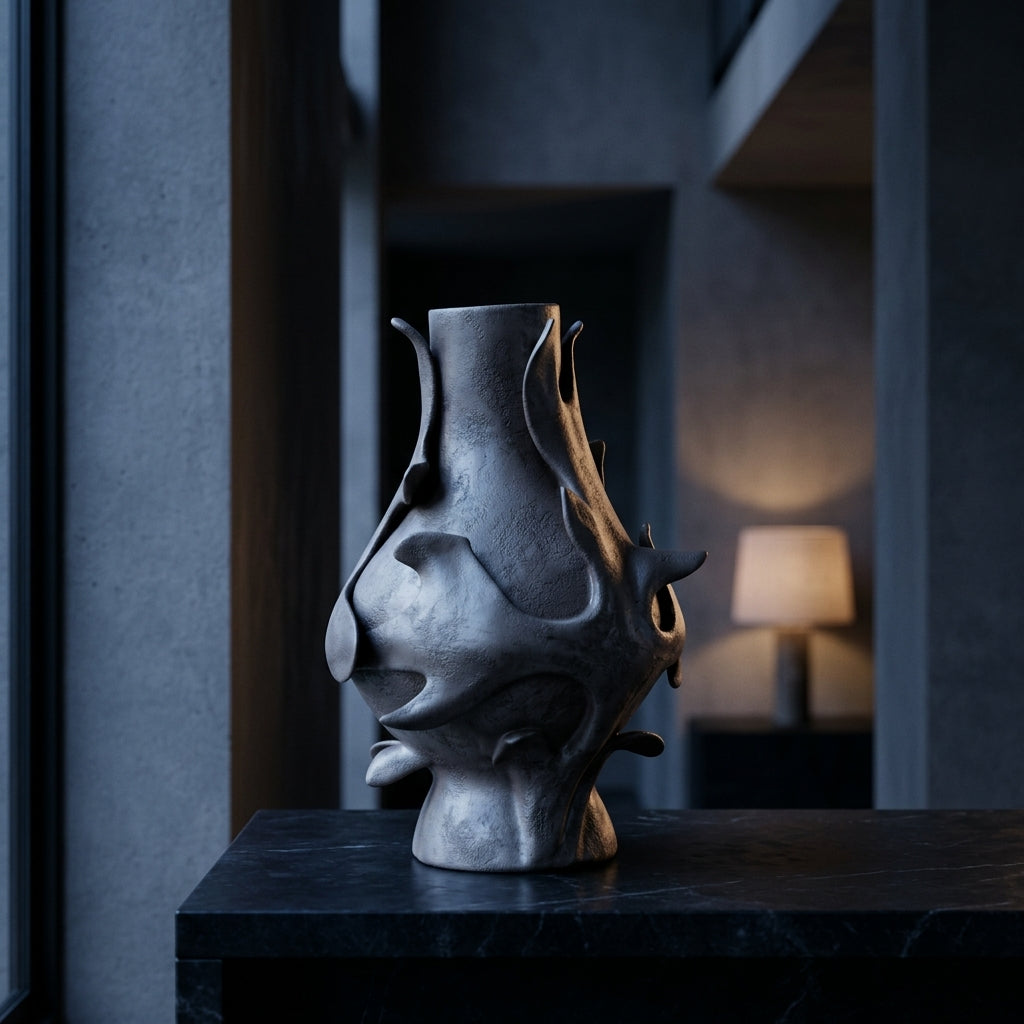

- Azimuth
- —
- Relief depth
- —
- Temperature
- —
A study, not a specification. Patina and shadow read differently in every room.
On the Corinthian Order
The Basket at Corinth
Vitruvius records the origin two centuries after the fact: a nurse in Corinth left a basket of a dead girl’s belongings at her grave, set a roof tile over it to keep out the weather, and left it standing on an acanthus root. By spring the plant had grown up around the basket, its leaves curling outward exactly where the tile’s four corners forced them to turn. The sculptor Callimachus — known in the city for the precision of his carving — is said to have seen the arrangement and taken the whole accident, basket and leaf and turned corner, as the design for a new capital.
Whether the story is fact or a workshop’s convenient account of a form that more likely evolved by trial, it fixed something for the next twenty-five centuries: Corinthian meant a leaf trained upward around a shape it did not choose. The obstacle became the rule, and every capital cut since has been a leaf obeying a basket that is no longer there.
This casting keeps the leaf. It removes the basket.
Basket, tile, and the four turned corners — after Vitruvius, Book IV
On the Orders
The Youngest Order
Doric came first, spare and load-bearing. Ionic followed, softened with a scroll. Corinthian came last — and alone among the three, it is not, at its root, a structural idea at all.
No base, and a capital reduced to two flat mouldings — the echinus and abacus — doing exactly what stone doing a job needs to do and nothing else. Doric is the order ancient writers called masculine: it tells you where the weight goes and stops talking.
The capital resolves into two opposed volutes — paired scrolls, usually read as a stylized ram’s horn or a roll of hair. Proportions run slimmer than Doric, the base gets its own mouldings, and the order was categorized by Vitruvius as the more refined of the first two.
Two tiers of carved acanthus leaves wrap the bell of the capital, with small volutes tucked at the corners almost as an afterthought. Athens adopted it slowly — the Choragic Monument of Lysicrates, c. 334 BCE, is among the earliest full exterior uses. Rome adopted it completely: the Temple of Castor and Pollux, the Maison Carrée, the portico of the Pantheon are all Corinthian. A capital like this takes measurably longer to carve than a Doric one, because every leaf has to be undercut deep enough to read as separate from the stone behind it. The depth of the carving is the cost, and the cost was always legible to anyone standing in front of the building.
Every other order tells you what is holding the roof up. Corinthian tells you what someone was willing to pay for.
On Persistence
Two Thousand Years of Discipline
No other single ornament has been carved, plastered, and moulded in an unbroken line for longer.
The form appears.
Athens takes another century to adopt it in full; the earliest surviving exterior use, the Choragic Monument of Lysicrates, dates to c. 334 BCE.
Rome makes it the default.
The Temple of Castor and Pollux, the Maison Carrée, the portico of the Pantheon. Rome does not invent the acanthus capital — Rome makes it the order of imperial display.
The leaf survives by growing stranger.
Flattened, interlaced, carved by masons copying copies of a Roman original none of them had seen.
Architects return with calipers.
Brunelleschi, Bramante, and Palladio measure the Roman ruins directly and restore the leaf to something close to its original proportion.
The order is re-imported wholesale.
Robert Adam and his contemporaries sketch the ruins first-hand and carry the order into English and American civic buildings by the hundred.
Still the default finish.
A courthouse column, a picture frame — drawn from the same two-tier template Callimachus is said to have set. Every one of those leaves was trained to stay inside its tier, its volute, its corner. This one was not.
On This Casting
The Lapse
Twenty-five centuries of discipline is what makes the failure of it legible. A leaf cannot be seen breaking its training unless the training is already known — which is why the rule had to come first, in the sections above, before this one means anything.
The rule was always the same: the leaf is drawn up and then stopped at a fixed boundary — the abacus, the volute, the edge of the tier. In this casting the tendrils lift away from the body in long curves that do not resolve into any boundary at all. They do not reach a corner and turn. They do not tuck under a scroll. They stop being carved mid-gesture, the way growth stops when whatever was training it has been taken away.
A builder recognizes a ruin not by damage but by the moment construction stopped following its own logic. This object was made already in that condition, on purpose.
Root
Rise
Reach
Arrest
L’Acanthe Pétrifiée
Every capital in the West has been telling the same leaf where to stop for two thousand years. This is the one that didn’t listen.
81.29 cm · reinforced gypsum stone composite · hand-finished, natural earth mineral wash. Pre-order — ships in 6–8 weeks.